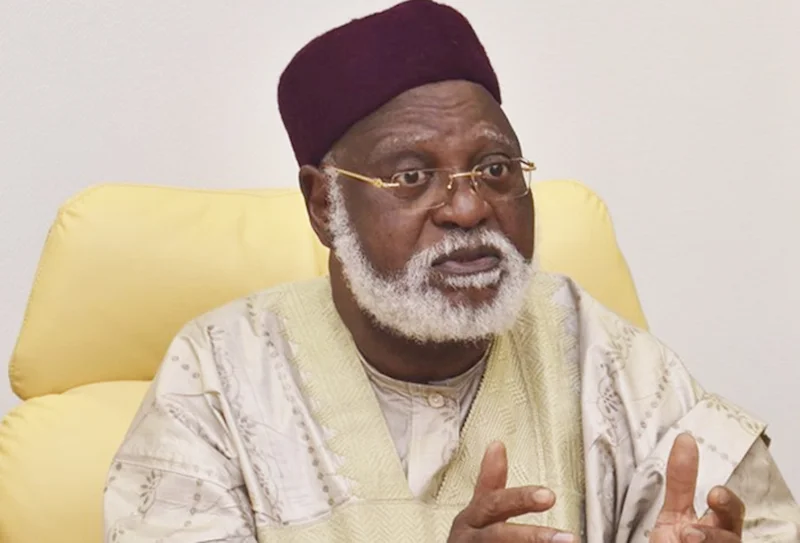
Former Head of State, Gen. Abdulsalami Abubakar (retd.), has said that some politicians who publicly championed the cause of Chief MKO Abiola during the June 12 political crisis were secretly aligned with the government, while others accepted financial support from both Abiola’s camp and his opponent, the late Bashir Tofa, during the 1993 presidential election.
The revelation is contained in Chapter 16 of his autobiography, Call of Duty, where he reflects on Nigeria’s political class and their conduct during major political events.
Abubakar described Nigerian politicians, regardless of political affiliation, as operating like “a tribe on their own,” often exploiting ethnic and religious differences in public while maintaining cordial relationships behind closed doors.
He recounted a story shared with him by the late Bashir Tofa, who said some politicians approached him during the 1993 election campaign requesting funds to mobilise support in their respective areas. After giving them the requested money, Tofa later discovered the same individuals at the office of the Social Democratic Party, where they were also working for Chief MKO Abiola.
According to Abubakar, Tofa eventually lost both Kano State and his own polling ward to Abiola despite the assurances he had received from those politicians.
The former Head of State also recalled an incident from the early 1980s while serving as Chief Instructor at the Nigerian Defence Academy. During the political crisis that divided the Peoples Redemption Party into rival factions loyal to Mallam Aminu Kano and Alhaji Abubakar Rimi, he said he visited a guest house and was surprised to find politicians from both opposing camps socialising, dining and interacting amicably despite their public disagreements.
He said the experience reinforced his belief that many political conflicts presented to the public are often at odds with the private relationships among political actors.
Abubakar further recalled watching one of the politicians he had seen at the gathering publicly criticise members of the rival faction on national television later that same day.
He added that an experienced First Republic politician once told him that, despite belonging to different political parties, many northern politicians regularly visited the late Premier of the Northern Region, Sir Ahmadu Bello, where they met, shared meals and discussed issues affecting their people before returning to publicly attack one another.
Reflecting on the June 12 crisis, Abubakar said many Nigerians were unaware of what was happening behind the scenes, noting that some individuals widely believed to be supporting Abiola were, in reality, working with the government.
He also stated that although he served as Chief of Policy and Plans at Army Headquarters during the annulment of the June 12, 1993 presidential election and was personally close to then military ruler, Gen. Ibrahim Babangida, he was neither a member of the Armed Forces Ruling Council nor directly involved in the transition programme.
Abubakar said he never demanded an explanation from Babangida over the annulment because he was not among those responsible for managing the political transition.
He urged Nigerians not to allow politicians to divide them along ethnic or religious lines, stressing that political rivals often maintain cordial relationships away from the public eye while ordinary citizens bear the consequences of political conflicts.
According to him, the masses should recognise that they are frequently used as pawns in political struggles and should remain united despite the divisions promoted by political actors.



Post comments (0)