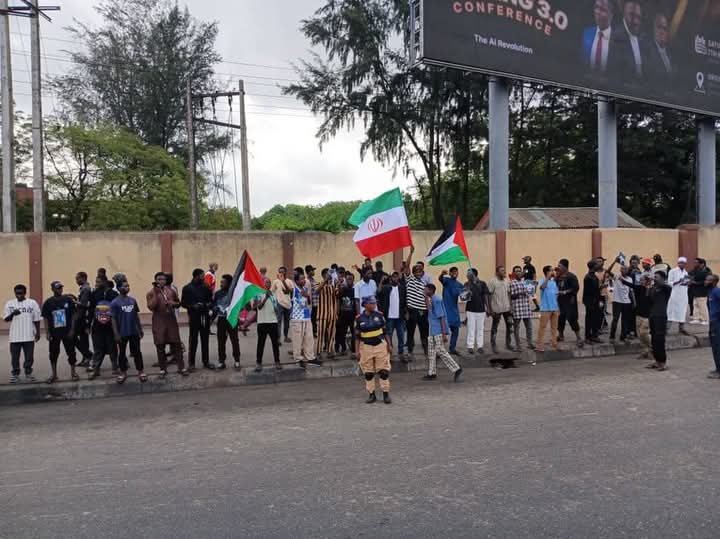
On Monday, the leadership of the South-West zone of the Islamic Movement of Nigeria (IMN) mobilised a significant gathering of members in Lagos State, directing their protest towards what they described as a flagrant act of aggression following the killing of Iran’s Supreme Leader, Ayatollah Ali Khamenei, in a joint United States–Israel military operation in the Middle East.
The demonstration, which began in the early hours around the Maryland axis, saw a steady stream of protesters converging on major thoroughfares, waving flags and bearing placards that bore slogans condemning the attack. Participants in the march repeatedly articulated their grievances in impassioned chants, calling for what they termed a united global condemnation of foreign intervention in sovereign nations. Many of the demonstrators expressed deep concern over what they characterised as unilateral military actions by powerful states that undermine international law and destabilise regions beyond their own borders.
The atmosphere around the protest was tense, with some residents and commuters expressing apprehension about the potential for disruption in the area due to the size and vocal nature of the crowd. While there were no immediate reports of violence or clashes with security personnel, the scale of the gathering prompted heightened awareness among onlookers.
At the centre of the protest was Muftau Zakariya, the South-West Coordinator of the IMN, who addressed journalists and supporters during the march. In his remarks, Zakariya explained that the demonstration was intended not only to register outrage over the targeted killing of the Iranian leader but also to articulate broader concerns about perceived patterns of military intervention by the administration of former U.S. President Donald Trump in the affairs of sovereign states.
Zakariya referenced several recent international crises as part of his critique, including what he described as the invasion of Venezuela and the resultant political and economic upheaval there. He also drew parallels with internal security challenges within Nigeria, suggesting that similar forms of external interference — whether direct or through diplomatic and strategic influence — had adverse consequences for the autonomy and stability of nations around the world.
Speaking to the larger goals of the protest, Zakariya emphasised that the IMN views such foreign policy interventions as primarily driven by strategic and economic interests, often at the expense of innocent civilians and local populations. He said the movement was especially alarmed by the implications of the Middle East conflict for global peace and for Muslim communities who feel a deep cultural and religious connection to the issues at stake.
Protesters wielded placards with phrases advocating justice, calling for the protection of human rights, and pleading for an end to what they described as hegemonic military practices. There were also moments of prayer and reflection as participants sought to underline the spiritual dimensions of their solidarity with the people of Iran and other nations affected by international conflict.
The demonstration in Lagos formed part of a wider expression of protest by IMN members across Nigeria, with similar actions reported in several northern states over the weekend, where crowds gathered to voice their condemnation and offer collective prayers for peace and divine intervention.
While the IMN leadership maintained that their protest remained peaceful, they reiterated their determination to continue advocating for what they see as the rights of oppressed communities and the need for reforms in global diplomacy that respect national sovereignty and human dignity.



Post comments (0)