President Bola Tinubu has asked the National Assembly to approve an upward review of the 2026 Appropriation Bill by ₦9 trillion, increasing the proposed budget from ₦58.4 trillion to ₦67.4 trillion.
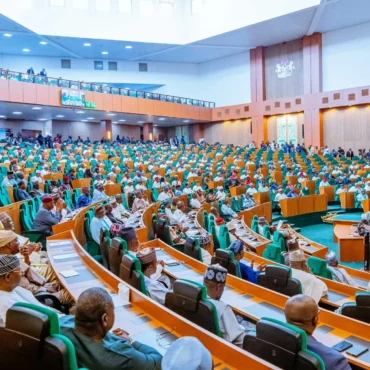
The request was conveyed in a letter read on the floor of the Senate on Tuesday by the President of the Senate, Godswill Akpabio, during plenary.
In the letter, President Tinubu explained that the proposed increase is aimed at improving fiscal transparency and ensuring the effective implementation of key government programmes and national priorities.
According to the President, the adjustment is being driven by three major factors. One of the reasons is the need to regularise and settle outstanding legal commitments carried over from previous budget cycles so they do not disrupt the execution of the 2026 budget.
He also stated that the proposed review would enable the government to properly account for existing public debt obligations within the fiscal framework. In addition, the upward adjustment is expected to make room for a limited number of strategic priority projects, while also aligning the 2026 financing plan in a way that protects macroeconomic stability and reduces pressure on the domestic financial market.
The revised request comes months after President Tinubu presented the 2026 budget proposal, which he titled “Budget of Consolidation, Renewed Resilience and Shared Prosperity,” to the National Assembly in December.
At the time, the President said the spending plan was designed to consolidate ongoing reforms, strengthen resilience across key sectors, and promote inclusive prosperity for Nigerians. He stressed that economic growth, investor confidence, and national development are closely tied to a stable and secure environment.
Under the original proposal, ₦5.41 trillion was allocated to defence and security, representing about 9.3 per cent of the total budget. The administration said the allocation reflected its commitment to tackling insecurity and safeguarding lives, property, and economic assets across the country.
The 2026 budget framework was built on what the government described as realistic, prudent, and growth-oriented assumptions. Key projections included expected revenue of ₦34.33 trillion, total expenditure of ₦58.18 trillion, ₦15.25 trillion for recurrent non-debt spending, and ₦26.08 trillion for capital expenditure.
The original proposal also projected a budget deficit of ₦23.85 trillion, representing 4.28 per cent of Nigeria’s Gross Domestic Product (GDP). According to the President, the deficit aligns with the government’s broader fiscal strategy and is intended to support development priorities without undermining economic stability.
President Tinubu also reiterated his administration’s commitment to fiscal discipline, transparent debt management, and efficient use of public resources, stressing that public spending must continue to support long-term economic reforms and sustainable growth.
The budget proposal is guided by the 2026–2028 Medium-Term Expenditure Framework (MTEF) and Fiscal Strategy Paper (FSP), which set out the key assumptions underpinning the spending plan.
Among the assumptions are a crude oil benchmark of $64.85 per barrel, projected oil production of 1.84 million barrels per day, and an exchange rate of ₦1,400 to one US dollar for the 2026 fiscal year.
The proposed upward review is expected to attract attention from lawmakers and economic stakeholders, as it would significantly increase the size of the budget and shape the government’s spending and financing priorities for the year ahead.
Once considered by the National Assembly, the revised appropriation proposal will determine the final fiscal framework for the 2026 budget cycle.


Post comments (0)