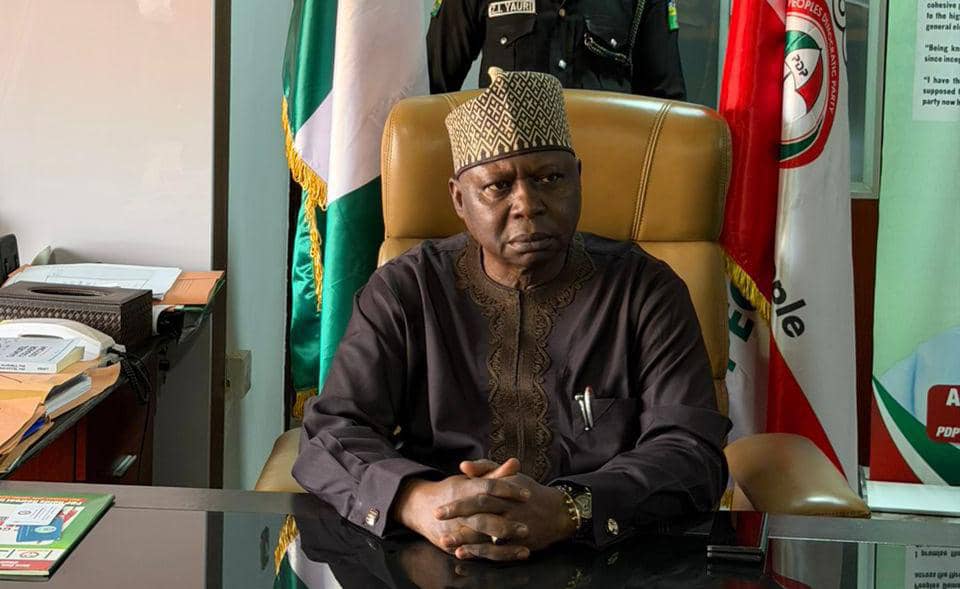
A High Court in the Federal Capital Territory (FCT) has issued an order for the arrest of Senator Kabiru Turaki (SAN), the Chairman of the National Working Committee (NWC) of the Peoples Democratic Party (PDP), following his failure to appear in court for arraignment. The court’s decision comes amid ongoing legal proceedings concerning a criminal charge filed against him, highlighting the seriousness of ensuring that defendants respond to summons issued by the judiciary.
Senator Turaki, a Senior Advocate of Nigeria (SAN) and former Minister of Special Duties, was expected to appear in court to take his plea on a one-count charge brought by the Inspector-General of Police. The charge alleges that he provided false information, and the court had scheduled a formal arraignment to hear his response. However, Turaki did not attend the hearing, prompting the presiding judge, Justice Peter Kekemeke, to issue a bench warrant for his arrest to compel his appearance.
The prosecution, led by counsel Usman Rabiu, informed the court that Turaki had been duly served with both the criminal charge and a notice of the hearing, yet he failed to appear. Rabiu requested the court to invoke Section 396(2) of the Administration of Criminal Justice Act (ACJA), 2015, which empowers the judiciary to issue a bench warrant in cases where a defendant deliberately absents themselves from court proceedings. The prosecution emphasized that the court’s intervention was necessary to maintain the integrity of the judicial process and ensure that the legal procedure is not undermined by nonappearance.
In his defense, Turaki explained that his inability to attend the court session was due to health reasons. He stated that he had instructed his lawyers to appeal the court’s order and seek a stay of execution, highlighting his intention to comply with the legal process despite his absence. Additionally, Turaki clarified that the petition which led to the criminal case dated back to 2022 and was not connected to his current role in the PDP, stressing that the matter predates his chairmanship and should be considered independently.
Turaki’s legal team, led by Abdulaziz Ibrahim (SAN), had earlier filed a motion seeking to quash the charge. The defense argued that at this stage, the presence of their client was not necessary, and requested the court to grant a five-day period to submit written addresses in support of the motion. However, Justice Kekemeke ruled that the absence of the defendant was unjustified, noting that the defense did not dispute the fact that Turaki had been formally served with both the charge and the hearing notice. The court emphasized that compliance with summons is a fundamental aspect of criminal proceedings, and failure to appear without valid justification undermines the administration of justice.
With the bench warrant now issued, law enforcement authorities are empowered to take steps to ensure Turaki’s presence in court. The ruling underscores the judiciary’s commitment to holding all individuals accountable under the law, regardless of position or status, and highlights the procedural requirements that govern criminal trials. The case remains active, and the court awaits the eventual appearance of the defendant so that the matter can proceed to a proper hearing, ensuring that the legal process is conducted fairly and in accordance with statutory provisions.
The development has drawn attention to the importance of timely compliance with court directives, the consequences of nonappearance, and the judiciary’s role in maintaining order in legal proceedings. It also reflects the mechanisms available to defendants and their legal representatives to challenge charges or seek judicial relief, while balancing the need for the court to enforce its authority and ensure that justice is not delayed.





Post comments (0)