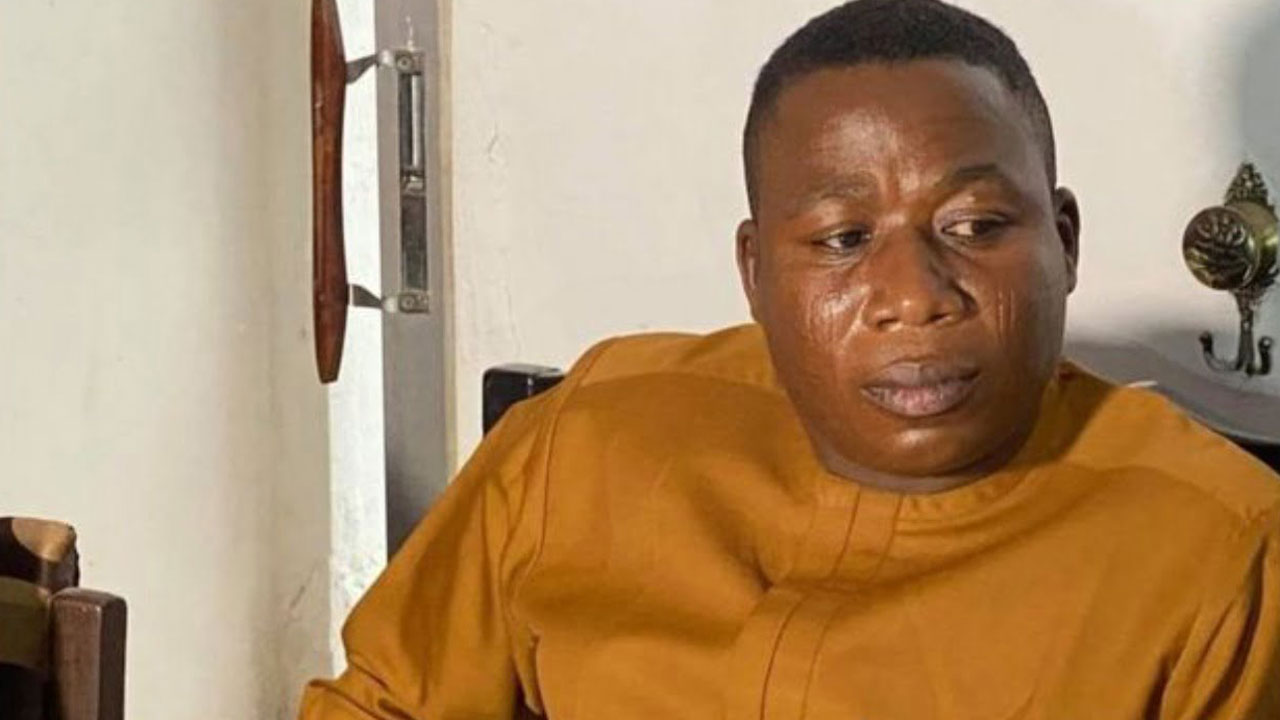
Yoruba nation agitator, Sunday Igboho, has stirred widespread public discussion after openly declaring that although he identifies as a Christian, he also makes use of traditional charms.
Igboho, whose real name is Chief Sunday Adeyemo, made the remarks in a video that has since gone viral across social media platforms. In the footage, he was seen addressing a gathering of traditional rulers, where he spoke candidly about his religious identity, upbringing, and personal beliefs.
During his address, the activist stated that his Christian faith does not prevent him from embracing traditional spiritual practices. He explained that he was born and raised in a Christian environment but had also been exposed to indigenous spiritual traditions from an early age. According to him, his background reflects a blend of influences that shaped his worldview.
He referenced his family history, noting that his father was known to be a traditional priest, commonly referred to as a babalawo, in Modakeke, Osun State. Igboho said he was trained in aspects of traditional spiritual practices and made it clear that he does not see a contradiction between professing Christianity and using charms. In his words, he embraces multiple religious expressions and considers them part of his identity.
His comments have triggered intense reactions among Nigerians, particularly on social media, where debates quickly emerged over the compatibility of Christianity with traditional African religious practices. While some individuals defended his position, arguing that religious syncretism is not uncommon in many African societies, others questioned whether such practices align with Christian doctrine.
Supporters contend that many Nigerians, especially in the southwestern region, often maintain cultural and traditional beliefs alongside formal religious affiliations. They argue that traditional spirituality forms part of Yoruba heritage and identity, and that historical interactions between Christianity, Islam, and indigenous beliefs have produced complex layers of faith expression.
Critics, however, insist that Christianity, as practiced in mainstream denominations, discourages reliance on charms or traditional spiritual objects. For them, Igboho’s statement raises theological concerns and challenges conventional interpretations of Christian teachings.
The development has also revived broader conversations about religious identity in Nigeria, a country where Christianity, Islam, and indigenous belief systems coexist, sometimes intersecting and sometimes clashing. Scholars have long observed that in parts of the country, especially within Yoruba communities, it is not unusual for individuals to navigate multiple spiritual influences shaped by family traditions and societal norms.
Igboho was born in Igboho, an ancient town in Oyo State’s Oke-Ogun region. His family later relocated to Modakeke in Osun State, where he spent much of his formative years. Over time, he rose to prominence as a vocal advocate for the Yoruba nation movement, often attracting national attention through his activism and public pronouncements.
His latest remarks add another layer to his public persona, blending political activism with personal reflections on faith and tradition. As discussions continue online and within religious circles, the controversy underscores the enduring complexity of religion, culture, and identity in contemporary Nigerian society.




Post comments (0)