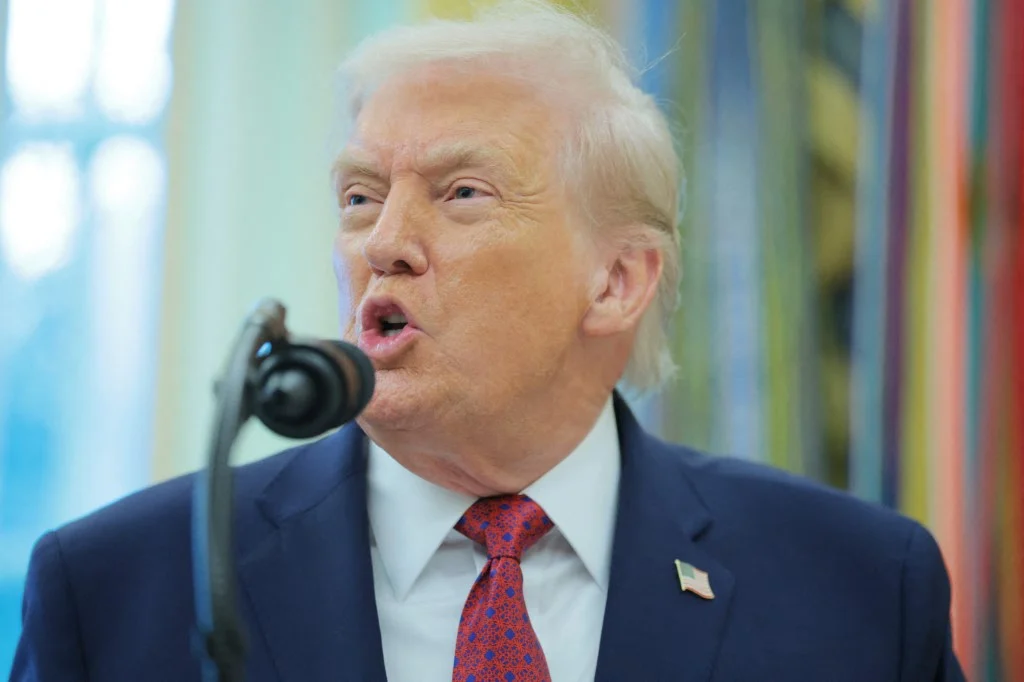
Global oil markets took centre stage on Tuesday after United States President Donald Trump intensified his rhetoric toward Iran, injecting fresh uncertainty into trading sessions that were otherwise muted due to public holidays across parts of Asia and the United States.
Crude benchmarks initially climbed on geopolitical concerns before giving up some gains. West Texas Intermediate (WTI) rose by more than one per cent, approaching the $64 per barrel mark, while Brent crude hovered just below $69 per barrel before easing slightly. The movement reflected investor sensitivity to developments surrounding Washington’s renewed pressure on Tehran, particularly ahead of diplomatic engagements scheduled in Geneva.
President Trump warned Iran of serious “consequences” if it failed to reach an agreement with the United States, escalating tensions that have simmered over multiple issues. The US administration has previously condemned Tehran over its handling of anti-government protests and has more recently sharpened its focus on Iran’s nuclear ambitions. Markets reacted cautiously, as traders weighed the possibility of further sanctions or military escalation that could disrupt oil supply routes in the Middle East — a region critical to global energy stability.
Despite the geopolitical backdrop, overall trading volumes were thin. Major Asian financial hubs including Shanghai, Hong Kong, Taipei, Seoul and Singapore remained closed for the extended Lunar New Year holiday, limiting regional participation. In the United States, markets were preparing to resume activity following the Presidents’ Day holiday, which had kept Wall Street closed on Monday.
Precious metals experienced downward pressure amid the subdued trading environment. Gold retreated below the $5,000 per ounce threshold, while silver recorded a sharper drop of about three per cent. Analysts attributed the pullback to profit-taking and cautious positioning ahead of renewed US market activity and further clarity on geopolitical developments.
In Japan, equities ended lower, with Tokyo’s main index slipping 0.4 per cent. The decline followed the release of data showing weaker-than-expected economic growth in the fourth quarter, underscoring the fragile state of the world’s fourth-largest economy. Market participants noted that with US markets closed for much of the previous day, Japanese trading lacked strong directional catalysts.
Currency markets showed moderate movement, with the dollar trading in the mid-153 yen range. The slightly weaker yen offered some support to export-oriented stocks, as a softer currency generally enhances the competitiveness of Japanese goods abroad. However, broader investor sentiment remained cautious amid limited global cues.
Elsewhere in the Asia-Pacific region, Sydney’s market posted modest gains of 0.2 per cent. The advance was partly driven by strong corporate earnings from mining heavyweight BHP, the world’s largest copper producer. The company reported a rise in half-year net profit, buoyed by robust demand for copper, a key component in electrical infrastructure and renewable energy technologies. The performance reinforced optimism around commodities tied to the global energy transition.
In Southeast Asia, Bangkok’s exchange climbed 0.5 per cent, shrugging off recently released data that pointed to sluggish domestic economic growth. Investor enthusiasm was instead fuelled by political developments following the decisive electoral victory of the Bhumjaithai Party earlier in the month, which has bolstered confidence in policy continuity and economic reform prospects.
Other regional markets showed mixed results. Mumbai and Manila edged higher, supported by selective buying in financial and industrial stocks, while Wellington dipped 0.5 per cent amid cautious sentiment and light trading activity.
Beyond traditional energy and equity markets, investors are also turning their attention to developments in artificial intelligence. Global technology executives and policymakers have gathered in New Delhi for the AI Impact Summit, a five-day event aimed at shaping international cooperation and governance frameworks for emerging AI technologies. The summit is expected to produce discussions on regulatory standards, ethical considerations, and cross-border collaboration, reflecting the growing influence of AI on economic growth and global competitiveness.
Additionally, senior officials from the US Federal Reserve, including Governor Michael Barr and San Francisco Fed President Mary Daly, are scheduled to address issues related to artificial intelligence and its potential implications for financial systems and economic policy. Their remarks are being closely watched for insights into how central banks view the intersection of rapid technological advancement and macroeconomic stability.
As markets reopen more fully in the coming days, traders are likely to remain highly responsive to geopolitical signals from Washington and Tehran, fluctuations in energy prices, and broader macroeconomic data. The interplay between political developments, commodity demand, and technological innovation continues to shape a complex and evolving global financial landscape.




Post comments (0)