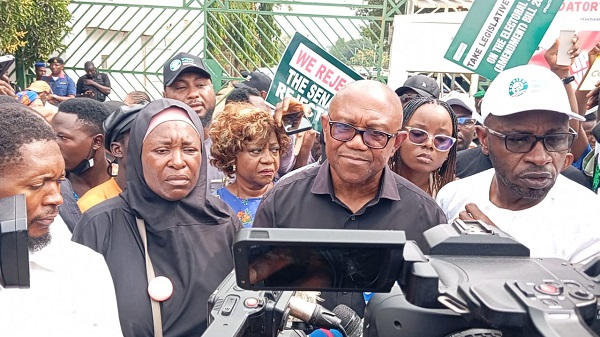
Former Labour Party presidential candidate, Peter Obi, on Monday led a protest at the National Assembly in Abuja, demanding the restoration of “real-time” electronic transmission of election results in the proposed Electoral Act Amendment Bill.
The protest, tagged “Occupy the National Assembly,” drew hundreds of supporters from the Obidient Movement and various civil society organisations. Demonstrators described the removal of the phrase “real-time” from the bill as a threat to electoral transparency ahead of the 2027 general elections.
The Senate had recently passed the Electoral Act 2022 (Repeal and Reenactment) Amendment Bill, 2026. However, critics have expressed concern that the deletion of the “real-time” provision from sections dealing with electronic transmission of results could weaken safeguards against electoral manipulation.
Although lawmakers clarified that electronic transmission was not entirely removed from the bill, protesters argued that the omission could allow room for interference during result collation and undermine public confidence in the electoral process.
Carrying placards with inscriptions such as “Our votes must count,” “No to electoral robbery,” and “Defend democracy,” the protesters marched from the Federal Secretariat to the National Assembly complex. Security operatives, including personnel of the Nigeria Police Force, Nigerian Army, and Nigeria Security and Civil Defence Corps, stopped the demonstrators at the main gate, preventing access to the premises.
Addressing journalists at the scene, Obi stressed the importance of credible elections in sustaining democracy and national development.
He warned against actions that could weaken democratic institutions, calling for stronger electoral safeguards to ensure transparency and accountability.
Also speaking, the National Coordinator of the Obidient Movement Worldwide, Dr. Yunusa Tanko, said the group would continue its protest until lawmakers explicitly reinstate real-time electronic transmission of election results in the amended law.
Tanko emphasised that electronic transmission was introduced to reduce human interference in elections and improve transparency, particularly following reforms implemented after past electoral controversies.
Another activist, Randy Peters, urged lawmakers to uphold democratic principles, vowing that the protest would continue until their demands were addressed.
Electronic transmission of election results has been widely regarded by civil society groups as a key reform to strengthen transparency and public trust in Nigeria’s electoral process.





Post comments (0)