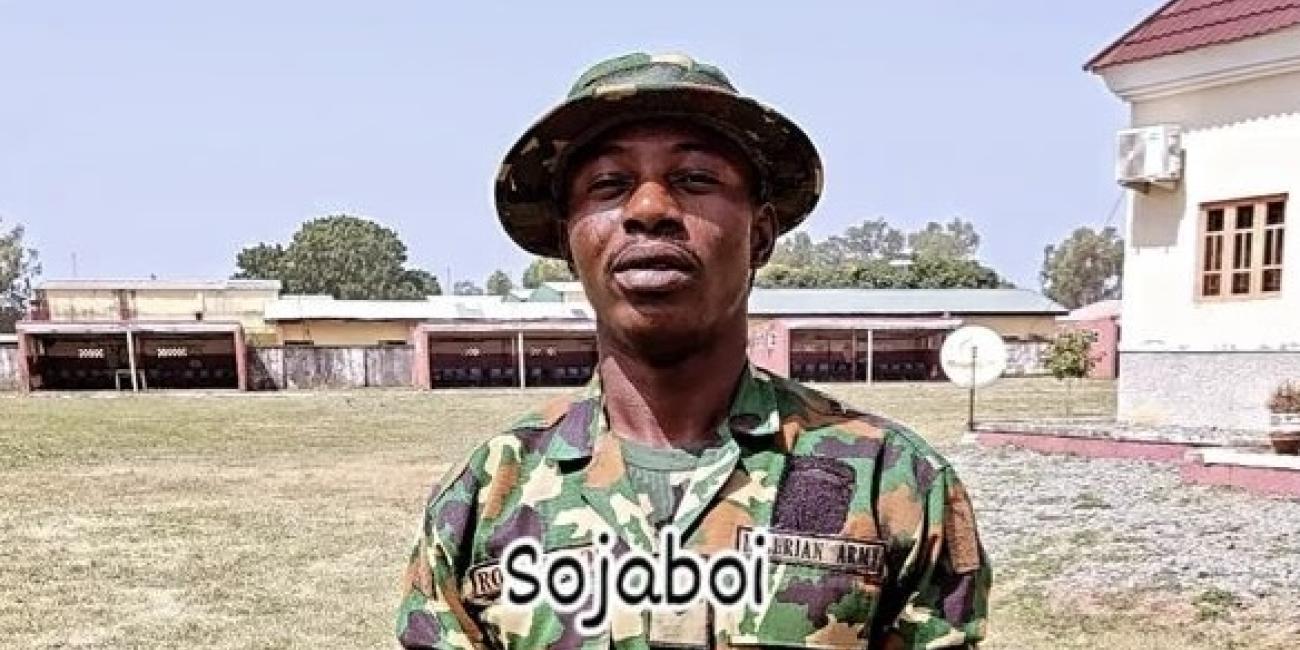
A dismissed Nigerian soldier has alleged that personnel of the Nigerian Army are forced to purchase their uniforms, boots, and even some protective gear with their own money despite receiving what he described as modest salaries.
The former soldier, Rotimi Olamilekan, popularly known as Soja Boi, made the claims while speaking during a podcast interview, where he opened up about his experience in service, his earnings, and the conditions under which many soldiers reportedly operate.
According to him, life in the military was financially difficult, especially before a recent salary adjustment. He claimed that his last salary before dismissal was a little above N100,000, while his monthly pay had previously been around N51,000 before the increase.
He said that even with allowances, survival remained extremely challenging, particularly for soldiers deployed to difficult and dangerous locations.
Olamilekan alleged that beyond the issue of low earnings, soldiers also bear the burden of purchasing basic work items that many Nigerians would assume are officially provided by the military.
According to him, uniforms are not freely issued in the way many expect, forcing personnel to buy them from their own salaries. He also claimed that the cost of these items is often high, making it even harder for lower-ranking soldiers to cope financially.
He said a standard military uniform can cost tens of thousands of naira, while a pair of boots may even exceed a month’s salary in some cases.
The former lance corporal further alleged that some essential protective items, including bulletproof vests and helmets, are often not readily available to regular soldiers except during special or ceremonial situations.
According to his account, such equipment may only appear when there are high-profile visits or special official events, leaving many personnel to operate in risky conditions without adequate protection.
He expressed concern over the dangers faced by soldiers deployed to frontline and conflict-prone areas, claiming that many of them work under life-threatening circumstances with limited support and insufficient equipment.
Olamilekan also spoke about his posting to the North-East, where he said he spent several years serving in Maiduguri and surrounding operational areas.
He claimed that although soldiers are often told they would be rotated after a certain period, many remain in active conflict zones far longer than expected.
According to him, he spent more than four years and several months in the theatre of operations, a period he suggested exceeded the standard deployment timeline.
His comments have stirred conversation online, especially among Nigerians concerned about the welfare, welfare structure, and operational readiness of security personnel battling insurgency and other security threats across the country.
The claims also add to growing public discussions around the conditions of service for military personnel, particularly those serving in high-risk areas where the demands of combat and security operations are intense.
As of the time of this report, there has been no official response from the Nigerian Army regarding the allegations.
The development is likely to reignite broader conversations about troop welfare, military funding, equipment provision, and the overall support system available to soldiers on active duty.




Post comments (0)