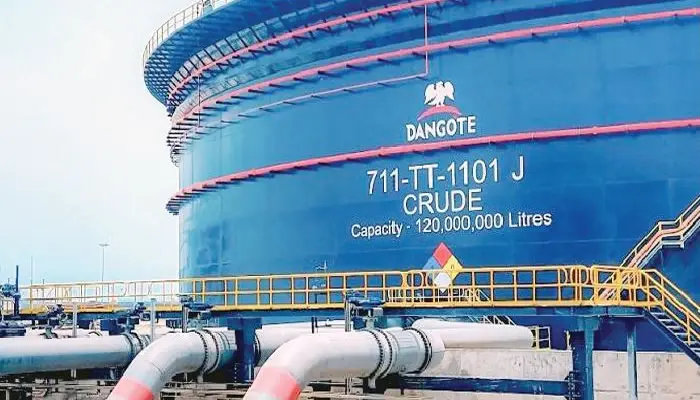
Nigerians may begin to experience some relief in the cost of petrol from Friday as fuel prices are expected to decline across filling stations nationwide following a fresh reduction in the ex-depot price of Premium Motor Spirit (PMS) by Dangote Refinery.
The refinery on Thursday announced a significant downward adjustment in its gantry price, cutting the cost of petrol by N85 per litre, from N1,285 to N1,200 per litre. The latest move is expected to trigger a corresponding reduction in pump prices across the country, especially among marketers and filling stations that source products directly or indirectly from the refinery.
The price review is already being seen as a major development in Nigeria’s downstream petroleum market, where motorists and households have in recent weeks been burdened by the steep rise in fuel costs. Industry watchers say the reduction could mark the beginning of a gradual easing in retail prices if market conditions remain favourable and international crude prices continue to stabilise.
The revised gantry price also places Dangote Refinery in a stronger competitive position against private depot owners, many of whom have been selling petrol within the range of N1,240 to N1,255 per litre. By lowering its loading price below that level, the refinery appears to be strategically positioning itself to attract more off-takers and regain influence over domestic fuel pricing.
With the new ex-depot rate now in effect, analysts estimate that retail pump prices at major filling stations could drop by between N50 and N70 per litre, depending on transportation costs, location, distribution margins, and marketers’ pricing strategies. If fully reflected at the pumps, petrol could begin to sell within the range of approximately N1,291 to N1,311 per litre in several parts of the country, although prices may still vary across regions.
The expected reduction is likely to be welcomed by millions of Nigerians who have been struggling with the impact of high transport fares, increased cost of goods and services, and the wider inflationary pressure caused by rising fuel prices.
Over the past few weeks, the country has experienced a sharp escalation in retail petrol costs, driven largely by volatility in the international oil market and the broader geopolitical tensions that disrupted global supply chains. Nigeria, despite being an oil-producing nation, has not been insulated from these developments, as local fuel pricing remains highly sensitive to crude oil movements, exchange rate pressures, import-related costs, and domestic supply logistics.
The recent surge in global crude prices, triggered by the escalation of hostilities involving Iran, the United States, and Israel, had pushed up the cost of petroleum products in many countries, including Nigeria. At the height of the tension, fears over possible supply disruptions in the Middle East — particularly around strategic energy corridors — led to a sharp rise in oil benchmarks and worsened pressure on fuel markets worldwide.
Although crude prices have remained elevated, they showed signs of moderation during part of the week, offering some breathing space to refiners and marketers. Both Brent crude and West Texas Intermediate (WTI) slipped below the $100 per barrel mark at some point before later recovering to around $107 and $93 per barrel respectively by Friday morning.
That temporary cooling in global oil prices appears to have created room for Dangote Refinery to revise its petrol loading price downward, especially amid growing public calls for local producers to reflect the easing market conditions in their pricing structure.
For many consumers, the expectation is that the refinery’s move will quickly filter down to retail outlets, particularly among independent and major marketers that depend on products supplied from the refinery.
The Independent Petroleum Marketers Association of Nigeria (IPMAN) has already indicated that its members are expected to align with the new pricing reality. Market operators believe that marketers sourcing from Dangote Refinery will have little choice but to adjust their pump prices downward in order to remain competitive and respond to consumer expectations.
Similarly, several filling station operators are expected to await fresh pricing directives from their respective head offices before effecting any formal changes at the pumps. In major cities such as Abuja, Lagos, Ibadan, Port Harcourt, Kano, and Kaduna, consumers are likely to closely monitor stations from Friday in anticipation of visible price adjustments.
If the new gantry rate translates effectively into lower retail prices, it would represent one of the first major signs of downward correction in the local fuel market after weeks of steep and painful increases.
In recent months, Nigerians have faced an increasingly difficult energy cost environment. Petrol prices in many locations rose by more than 50 per cent, with some outlets in Abuja and other urban centres selling within the range of N1,361 to N1,370 per litre, compared with approximately N875 to N900 per litre just a few months earlier.
That rapid jump in pump prices significantly affected daily life across the country. Commercial transport fares surged, logistics and haulage costs climbed, and businesses passed rising operating expenses onto consumers. The knock-on effect was felt across food markets, school transportation, power generation for small businesses, and the general cost of living.
The latest development is therefore being viewed not only as a market adjustment but also as a potentially important relief point for an economy already under pressure.
Dangote Refinery, which has become a major force in the country’s fuel supply chain, has played an increasingly central role in shaping domestic petrol pricing since it began releasing products into the Nigerian market. However, the refinery has also faced criticism in recent months after implementing multiple upward reviews in its petrol loading price, each of which contributed to fresh increases in pump prices nationwide.
Industry observers note that the refinery has revised its petrol price upward several times in recent months in response to changing crude oil costs, operational expenses, and broader market realities. Those repeated increases have had a direct impact on the retail market, with many Nigerians closely tracking every adjustment made at the gantry because of its immediate effect on household expenses and transport costs.
This latest reduction, however, may signal a more flexible pricing pattern in the market, one that is increasingly responsive to both international oil trends and local competitive dynamics.
Experts say the extent to which consumers will fully benefit from the new price cut will depend on how quickly marketers pass on the savings and whether other cost pressures — such as foreign exchange fluctuations, transportation charges, and storage expenses — remain stable.
There is also the question of sustainability. While the current reduction offers hope of short-term relief, energy analysts warn that any fresh escalation in geopolitical tensions or a sudden rebound in crude prices could once again reverse the trend and push local fuel prices upward.
For now, though, the reduction has injected a sense of cautious optimism into the market.
Motorists, transport operators, manufacturers, and small business owners will be hoping that the latest adjustment is not only implemented promptly but also sustained long enough to bring broader economic relief.
As Friday approaches, all eyes will be on filling stations nationwide to see whether the expected reduction in pump prices becomes a reality and whether Nigerians can finally begin to feel some measure of respite after weeks of painful fuel costs




Post comments (0)