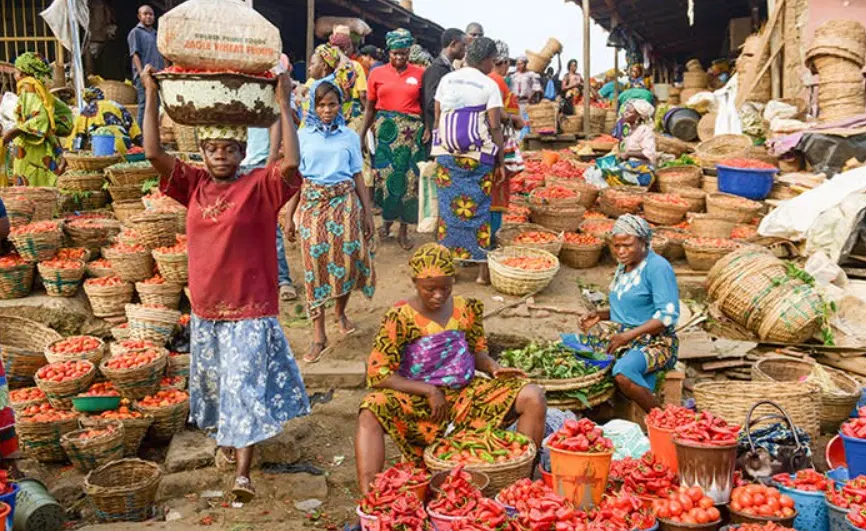
Food price increases driven by year-end festive demand and lingering insecurity emerged as the main source of inflationary pressure in November 2025, pushing Nigeria’s month-on-month (MoM) headline inflation rate to 1.22 per cent, the highest level in four months. Analysts expect a similar trend in December.
Data from the Consumer Price Index (CPI) report show that MoM food inflation also rose to 1.13 per cent in November, the highest in three months, reflecting higher average prices of several food items. The increases were largely attributed to supply disruptions, higher transportation costs and seasonal demand ahead of the festive period.
Despite the monthly uptick, headline inflation on a year-on-year (YoY) basis continued its downward trajectory for the eighth consecutive month, easing to 14.45 per cent from 16.05 per cent in October. The CPI rose to 130.5 in November from 128.9 in the preceding month, indicating a faster increase in average price levels on a monthly basis.
On a YoY basis, headline inflation in November 2025 was significantly lower than the 34.60 per cent recorded in the corresponding period of 2024, reflecting base effects from the rebased index. The twelve-month average inflation rate also declined to 20.41 per cent, compared with 32.77 per cent in November 2024.
Food inflation stood at 11.08 per cent on a YoY basis in November, a sharp moderation from 39.93 per cent a year earlier, largely due to the change in the base year. However, on a MoM basis, food inflation climbed from a contraction of 0.37 per cent in October to 1.13 per cent in November, driven by price increases in items such as dried tomatoes, cassava tubers, periwinkle, ground pepper, eggs, crayfish, melon seeds, oxtail and fresh onions.
Core inflation, which excludes volatile agricultural produce and energy prices, also eased. On a YoY basis, core inflation declined to 18.04 per cent in November from 28.75 per cent a year earlier. On a MoM basis, it slowed to 1.28 per cent from 1.42 per cent in October, suggesting some moderation in underlying price pressures outside food and energy.
The report highlighted wide disparities in inflation across states. On a YoY basis, all-items inflation was highest in Rivers, Ogun and Ekiti states, while Plateau recorded the lowest increase. On a MoM basis, Bayelsa, Gombe and Edo posted the sharpest increases, whereas Plateau, Delta and Kaduna recorded declines.
Food inflation followed a similar pattern across states. On a YoY basis, Kogi, Ogun and Rivers recorded the highest food inflation rates, while Imo, Katsina and Akwa Ibom experienced the slowest increases. On a MoM basis, Yobe, Katsina and Ondo saw the strongest food price growth, while Imo, Nasarawa and Enugu recorded month-on-month declines.
Economists attribute the November MoM acceleration largely to insecurity affecting food supply routes and rising logistics costs. They note that food prices typically rise in December due to festive demand, suggesting that monthly inflation pressures may persist in the near term. However, improved security conditions and supply-side interventions could help moderate prices in early 2026.
Analysts also note that the continued deceleration in YoY inflation signals improving macroeconomic stability, supported by tighter monetary conditions, a more predictable foreign exchange environment and gradual improvements in supply chains. Nevertheless, they caution that monthly inflation remains sensitive to seasonal demand, transport disruptions and structural weaknesses in food storage and distribution.
Commenting on the data, the Presidency said the continued decline in annual inflation reflects the impact of ongoing economic reforms. It noted that the November figure fell below the government’s 2025 inflation target, describing the outcome as evidence of disciplined economic management and policy consistency, while maintaining that further efforts are needed to sustainably reduce food-driven inflation pressures.




Post comments (0)